Why a Glossary Is the Highest-Leverage AEO Content You Can Publish


"What is X" is among the most common shapes of question people put to an assistant, and a glossary is the only content format built specifically to answer it. One page, one term, one definition, marked up so a machine knows exactly which sentence is the answer.
That alignment between format and question is why glossaries punch above their weight — and why so many of them still fail.
Picture the actual exchange: someone asks an assistant "what is answer engine optimization," and somewhere in its retrieval step it finds forty pages that half-answer the question and one page that fully answers it in the first sentence. The one page wins, almost by default — not because it out-ranked the others, but because it was built for exactly this shape of question and nothing else was.
Why the format works
It matches the question exactly
An article about six related concepts gives a model six partial answers. A glossary entry gives it one complete one, at a URL whose entire purpose is that term. There is no ambiguity about what the page is for.
Compare that to a homepage or a product page, which is built to answer a dozen different questions passably rather than one question completely. A model retrieving from either has to guess which sentence is the relevant one. A glossary entry removes the guess.
It has purpose-built structured data
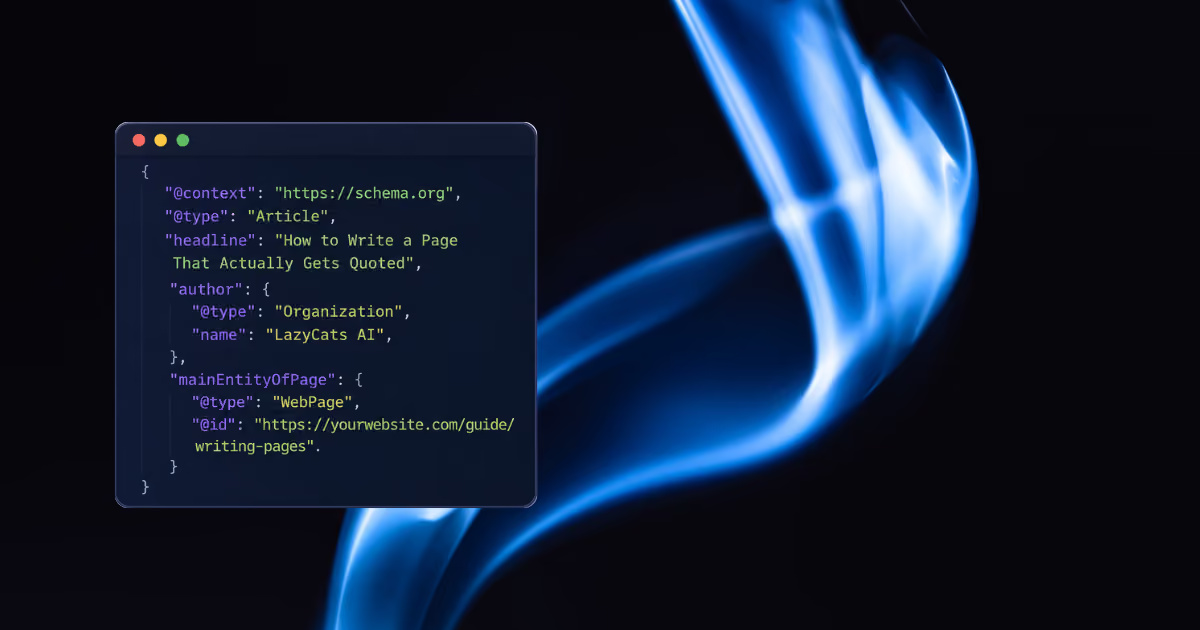
DefinedTerm schema exists for precisely this: stating that a string is a term and a sentence is its definition. Nothing else in the schema vocabulary is so narrowly targeted.
Grouping entries under a DefinedTermSet tells a machine that forty pages form one coherent reference work rather than forty unrelated posts.
It builds topical authority honestly
Forty interlinked pages covering one subject demonstrate coverage in a way a single long article cannot. And unlike most attempts at topical authority, the linking is natural — terms genuinely reference other terms, so the internal structure writes itself.
Glossary vs the other formats you could use instead
It helps to see the format next to the alternatives, because the temptation is always to fold definitions into something else — a paragraph in a blog post, a bullet in an FAQ, a footnote on a pricing page. Each of those can technically contain a definition. None of them are built for the moment someone asks only that.
None of these formats is wrong — a comparison page still wins comparison queries, and a blog post is still the right home for analysis. The point is narrower: for the single most common question shape, "what is X," nothing else is purpose-built the way a glossary entry is, which is exactly why it is worth building even though it will never close a deal on its own.
What a well-built glossary entry actually contains
The format only pays off if the entry itself is built correctly, and that structure is more specific than most teams assume.
The first sentence is the entire asset. It should define the term completely, without requiring the rest of the page, because that is the sentence most likely to be lifted verbatim into an answer. Everything after it is context: a short paragraph on why the term matters, one worked example if the term is abstract enough to need one, and links to two or three related terms a reader — human or model — would reasonably want next.
What it should not contain is a sales pitch. A definition that ends with a call to action reads as marketing to a model deciding whether to trust it as a neutral reference, and neutral is exactly the reputation a glossary is trying to build.
Why most glossaries fail anyway
Every entry is the same length
Forty pages of a hundred and ten words each, identical in structure, published on the same day. That uniformity is the signature of bulk generation, and both search systems and human evaluators recognise it.
Real reference works are uneven. The central terms get depth; the mechanical ones get a paragraph. Matching that unevenness is not cosmetic — it is what makes the collection read as edited rather than produced.
Nothing links to anything
A glossary where entries do not reference each other is forty orphan pages sharing a URL prefix. The single highest-value thing you can do after publishing is connect them — term to term, term to article, term to product page.
The definition contradicts itself across the page
The definition in the schema, the first sentence of the page and the meta description should be identical. When they differ, a model has three versions to choose between and may not pick yours.
It is written for the industry, not the reader
A definition that uses three other pieces of jargon to explain one has moved the problem rather than solved it. The test is whether someone outside your field could read it once and repeat it.
Nobody ever revisits them
A glossary published once and never opened again slowly drifts out of date — a term's common usage shifts, a competitor redefines it, an industry standard changes the accepted phrasing. Static reference content ages worse than most people expect, because nothing about a definition page signals when it was last checked. The review date mentioned below is not a formality; it is the only visible evidence that the page is still accurate.
How to build one that works
- List the terms your buyers actually encounter, not the ones your industry likes. If nobody asks about it, a page for it earns nothing.
- Write one clean sentence per term — answer-first, no jargon, self-contained. This sentence is the asset. Everything else is support.
- Tier the depth deliberately. Head terms deserve four hundred words. Mechanical terms deserve a hundred and fifty. Forcing them all to the same length is what makes a glossary look automated.
- Add DefinedTerm schema with the definition matching the page exactly.
- Link terms to each other wherever one genuinely explains another.
- Put a visible review date and a named author on every page. Reference content is judged on whether it is maintained.
- Track which terms actually get cited. Once assistants are citing pages, ask them the exact questions and note which entries come back verbatim versus which get paraphrased or skipped — that tells you which ones need rewriting first.
How AI models actually use these pages
The mechanism is retrieval, not memorization. When a model gets a definitional question, it does not recall your glossary from training — it retrieves candidate pages at query time and reads the DefinedTerm markup or first sentence to decide which candidate answers the question fastest.
That means a glossary entry keeps earning citations long after it was written, unlike a blog post whose relevance fades as the conversation moves past the moment it was published. It also means the reverse is true: a page can sit unread for months and then start getting cited the day a competitor's page goes down or a schema error breaks their markup. Reference content is judged on being retrievable and correct at the moment someone asks, not on being new.
The honest limitation
A glossary will not win your commercial questions. Nobody asking which tool to buy is going to be sold by a definition page.
What it does is establish that you understand the subject well enough to explain it, at a scale that is hard to fake, on the exact question shape assistants handle most often. That builds the association — your brand and this topic — which is what gets you named later, when someone asks the question that does have buying intent.
It is upstream work. Treated as a lead generator it disappoints. Treated as the foundation everything else links back to, it is the cheapest topical authority available.